
EVERIAL Canada transforms your physical and digital documents into structured, validated data that is ready to feed into your business applications and mission-critical systems. This IDP approach combines specialized software, OCR, artificial intelligence, and human review to automate document processing, reduce manual data entry, and accelerate your operations.
70 MILLION IMAGES PROCESSED EACH YEAR
Images that have been digitized, recognized, classified, indexed, or enhanced to produce information that can be used directly.
This offering combines a document management service, capture solutions, and intelligent processing tools.
Intelligent document processing, also known as IDP, uses a variety of technologies to recognize, classify, index, and extract the information contained in a document.
It transforms unstructured or semi-structured data into organized, validated data that can be used by a business application, management software, or mission-critical system.
The service supports documents from various sources: paper documents to be scanned, scanned files, PDFs, images, faxes, emails, and email attachments.
Each source can be integrated into a coordinated processing workflow. The operations applied are tailored to the format, document type, and your company’s business rules.
Optical character recognition, or OCR, converts an image of a document into machine-readable text. An intelligent recognition layer then analyzes its layout, characters, words, regions, and context.
Intelligent processing tools can thus identify the document type, extract relevant fields, and apply verification and validation rules tailored to your business processes.
Thanks to intelligent automation, the software handles repetitive tasks. Ambiguous documents, hard-to-read content, and exceptions can be routed to human validation.
This combination helps ensure accuracy, quality, and traceability in processing. EVERIAL Canada’s offering is available as a service or as a software solution, depending on the level of control and autonomy your organization requires.
Every day, a company receives paper documents, PDF files, emails, forms, and attachments. When processing these documents relies primarily on manual tasks, teams waste time and it becomes more difficult to ensure data quality.
Your teams are retyping data that is already contained in the documents.
Each type of document may require different reading, structuring, and management rules.
The tracking of documents, exceptions, and validations remains scattered across several tools.
Your company must be able to handle peaks in activity without compromising accuracy, turnaround times, or productivity.
Data that has been entered or extracted incorrectly—such as a misfiled document—can delay the processing of an invoice, an order, or a customer file.
Intelligent processing allows you to gradually automate these workflows, starting with the highest-priority documents and operations. This enables the solution to be tailored to your environment, your business rules, and your level of maturity.
The solution recognizes each invoice and then extracts relevant information, such as the supplier, invoice number, date, amount, taxes, and order reference.
The validated data can then be integrated into an ERP or accounting software system to speed up processing and payment, while reducing manual tasks.
The solution can identify the type of request, extract key data, and automatically route the document to the appropriate process, department, or application.
This use case is particularly well-suited for organizations in the public, financial, and insurance sectors.


Intelligent processing makes it possible to classify, index, and enrich the documents that make up a medical record. Each document can be matched to the correct patient or record based on available data and the rules defined by the organization. The goal is to improve traceability, the reliability of information, and the efficiency of the teams’ work.
Recognition tools and business rules can help identify specific information, such as the parties involved, dates, references, or document categories. The extracted data then makes it easier to classify, search for, and route the document. Human validation can still be used when the nature or complexity of the content requires it.
EVERIAL Canada supports businesses and organizations that handle large volumes of documents, sensitive data, and regulated processes. The solution is tailored to the specific needs of each industry, the organization’s business rules, its confidentiality requirements, and the structure of its business applications and mission-critical systems.
Financial
Insurance
Medical
Municipal
Government
01
The system receives documents from the defined sources: scanner, secure drop box, digital mailroom, email, PDF file, image, or business application. This first step centralizes incoming documents and marks the start of automated document workflow processing.
02
The image can be straightened, cleaned up, or enhanced to make it easier to read. Optical character recognition (OCR) then converts the printed characters into text that can be processed by software. Depending on the project’s requirements, recognition and artificial intelligence models can also analyze the document’s structure, layout, and type.
03
The intelligent processing software automatically identifies and classifies the document. It then extracts relevant data, such as a file number, an amount, a date, a supplier, or an order number. Each piece of data can be validated against a reference system, a database, or a business rule defined in collaboration with your organization.
04
The solution applies confidence thresholds to detect uncertain data and potential errors. Documents that meet the defined criteria automatically proceed to the next stage of processing. Exceptions are flagged for human review in order to verify or correct the data, document, or result obtained.
05
The processed document and its structured data are transmitted to the ERP, EDM, IDM, a line-of-business application, or a mission system. Authorized users can thus access the information within their familiar environment. Depending on the chosen configuration, this integration can also trigger a task, an operation, or a workflow and facilitate decision-making.
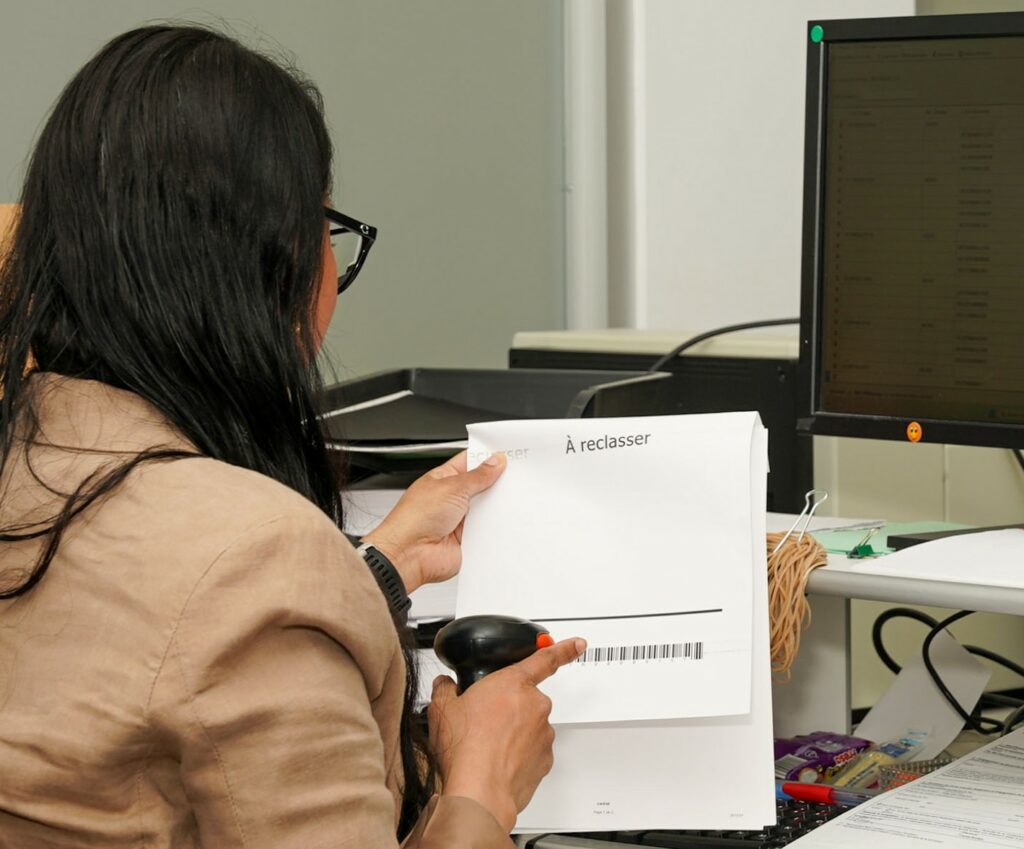


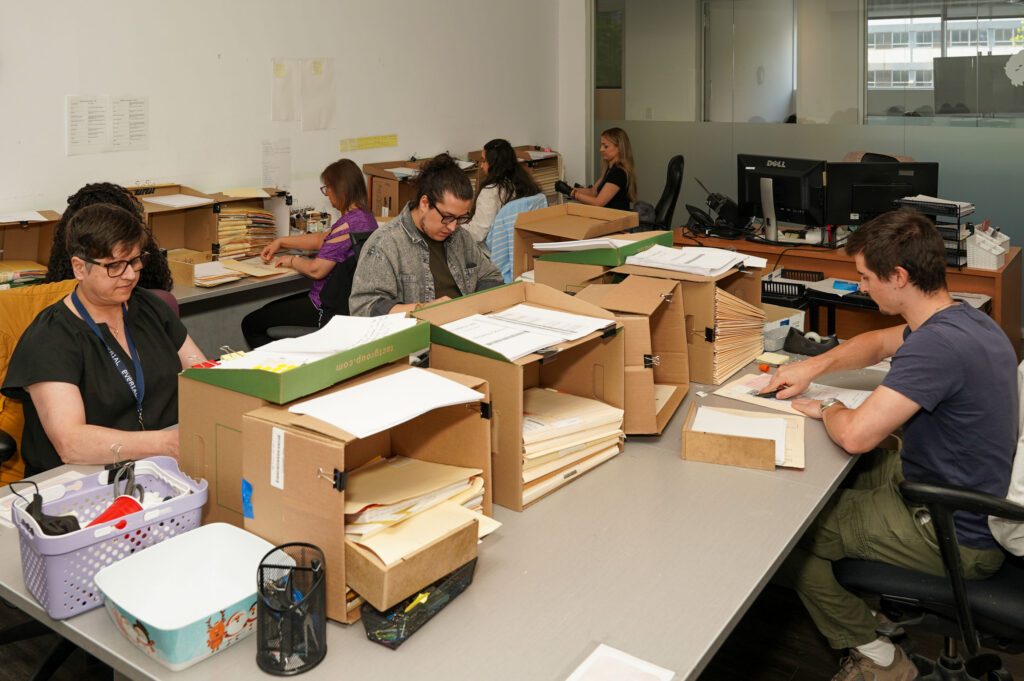
EVERIAL Canada analyzes your documents, volumes, systems, and objectives to determine the data to be extracted, the business rules, and the necessary validations.
A processing workflow is then configured and tested using representative samples, and subsequently fine-tuned before being rolled out into production. Depending on the selected mode, our teams handle integration, training, and follow-up to gradually automate processes in accordance with your organization’s requirements.
Automated document processing transforms repetitive document-related tasks into structured, controlled workflows. It simplifies teams’ day-to-day work while maintaining the necessary validations for sensitive, uncertain, or complex data.
Recognition, classification, and extraction reduce the time between receiving a document and integrating it into the business process.
This time savings allows your teams to access the information they need more quickly to process a request, submit an invoice for payment, or follow up on a case.
Automation handles part of the document capture, classification, indexing, and routing.
It can reduce the time and costs associated with manual operations, while allowing teams to focus on exceptions and higher-value-added activities.
Each piece of extracted data can be verified against a business rule, a reference system, a database, or a confidence threshold.
These checks reduce the risk of errors and improve the reliability of the information transmitted to your business applications and mission-critical systems.
The system automates the processing of documents that meet the defined criteria and routes more complex cases to the appropriate personnel.
This organization helps your company handle fluctuations in volume while maintaining the expected levels of quality, turnaround time, and service.
Intelligent document processing is configured to integrate with your existing tools and processes. Depending on the project’s requirements, the solution can also generate tracking data, processing logs, or reports to monitor the operations performed.
It operates upstream of your management software: documents are recognized, classified, enriched, and validated before being sent—along with their structured data—to the relevant applications.

These figures demonstrate EVERIAL Canada’s ability to implement intelligent document processing projects and to configure classification and extraction according to a variety of document structures.
We use your documents, data, and business rules as a starting point to build the right level of automation.
The goal: to provide your systems with reliable, verified information that your teams can use immediately.

Kevin COLMARD
Sales Manager – EVERIAL Canada
Data protection is taken into account at every stage of processing, from the receipt of documents to the transmission of data into your systems. The measures implemented are determined based on the sensitivity of the content, your organization’s requirements, and the scope of each project.
Access controls, traceability, validation rules, and transfer mechanisms help ensure the confidentiality, integrity, and reliability of the information being processed.

Intelligent document processing, also known as IDP, uses OCR, artificial intelligence, machine learning, and business rules.
It is used to recognize, classify, index, extract, and validate the information contained in a document. This processing thus produces structured data that can be integrated into a business application or a management system.
OCR converts the characters in an image into text that a computer can read.
Intelligent processing goes a step further by adding data classification, indexing, extraction, validation, and integration. This enables it to identify the type of document, interpret its role in the business process, and route the information to the appropriate system or workflow.
In particular, the solution can automate the processing of invoices, purchase orders, forms, requests, contracts, medical records, and administrative documents. It can handle documents from a variety of sources: scanned paper documents, images, PDF files, faxes, emails, attachments, and other electronic files.
Document automation can fully handle simple, predictable, and sufficiently stable documents. By reducing manual processing and repetitive tasks, it allows for better use of available resources and can help lower processing costs.
The use of intelligent processing does not rule out human intervention. Human oversight remains essential for handling exceptions, hard-to-read characters, sensitive data, or insufficient confidence thresholds.
Depending on the project documents and objectives, intelligent processing can utilize various artificial intelligence technologies.
Machine learning helps the model identify patterns and categories based on examples. Depending on the documents being processed and the quality of the training data, it can also help improve the accuracy of classification and extraction.
Deep learning can improve the recognition of layouts, images, or documents with greater variability. Its use depends on the specific need, the number of available examples, and the expected level of accuracy.
NLP, or natural language processing, can analyze text, its context, and the relationships between pieces of information in order to better interpret the content of a document.
RPA, or robotic process automation, primarily replicates repetitive, predefined actions within a software program or across multiple applications.
An IDP solution operates upstream to recognize the document type, classify its content, extract relevant data, and validate it before passing it on to an RPA, a workflow, or a business application.
The two technologies can therefore be complementary: IDP converts the document into actionable data, while RPA uses that data to execute the subsequent steps in the workflow. Combining them can enable end-to-end document processing automation, depending on the systems and rules defined for the project.
Yes, when the technical environment supports the exchange of documents and data. Depending on the systems involved, integration can be achieved through APIs, file transfers, or secure repositories to automatically transmit the extracted information to an ERP, EDM, IDM, or business application.
Output formats, available APIs and other interfaces, security requirements, business rules, and integration methods are validated during the requirements analysis.
The service model is suitable for organizations that wish to outsource all or part of their document processing to EVERIAL Canada and benefit from capacity tailored to their volumes and service levels.
Acquisition mode allows you to use the solution in your own environment and retain operational control over the processes. Implementation can be supported by consulting, integration, training, and support services.
The choice depends, in particular, on the volumes to be processed, internal resources, the technical environment, the organization’s strategy, and the desired level of control.
EVERIAL Canada supports you at every stage of your document management processes, from document receipt and processing to management, automation, and archiving. Discover the services and solutions that can complement your project.
We handle your document management processes, from scanning to archiving.
Software solutions designed to capture, manage, and automate your document workflows.
This initial contact is non-binding.
A specialist will analyze your needs, your documents, and your systems before making any recommendations.